

Credit cards are great for managing your money, but they can also cost a lot of money if you don’t know this one thing:
Rates of Interest on Credit Cards
When beginners see terms like APR, interest charges, minimum payments, and grace periods, they often get confused.
This simple guide will help you understand credit card interest rates so you can use credit cards wisely and stay out of debt.
What Is the Interest Rate on a Credit Card?
When you borrow money and don’t pay it back in full, the bank charges you extra money in the form of credit card interest.
- If you pay off your balance on time, you won’t have to pay interest.
- If you carry a balance, though, interest will be added.
Interest is basically the fee you have to pay to borrow money from a credit card company.
What is the Annual Percentage Rate (APR)?
APR is short for:
Rate of Interest per Year
It is the yearly interest rate that is added to unpaid balances.
For example:
Your credit card’s APR is 20%, which means that the bank can charge you up to 20% interest every year on the amount you don’t pay.
The APRs on most credit cards are between:
15% to 35%
If you don’t pay on time, a higher APR means a higher cost.
How does interest on credit cards work?
You only have to pay interest if you don’t pay the full balance on your statement.
Here’s how it works:
- You use the card to buy things.
- The bank sends you a statement every month.
- You have a date to pay by.
- No interest if you pay in full
- If you only pay part of the bill, interest starts to add up
What is a period of grace?
You can pay your bill without interest during the grace period.
Most credit cards give you:
20–30 days of grace period
If you pay off your balance in full during this time, the bank won’t charge you any interest.
Example:
- Buy date: January 5
- Date of statement creation: January 30
- Due date: February 20
✅ No interest if you pay before February 20.
What Happens if You Only Pay the Minimum?
This is where a lot of people get into debt.
The minimum payment is the least amount you need to pay to keep your account in good standing.
But interest will be charged on the rest of the balance.
Example:
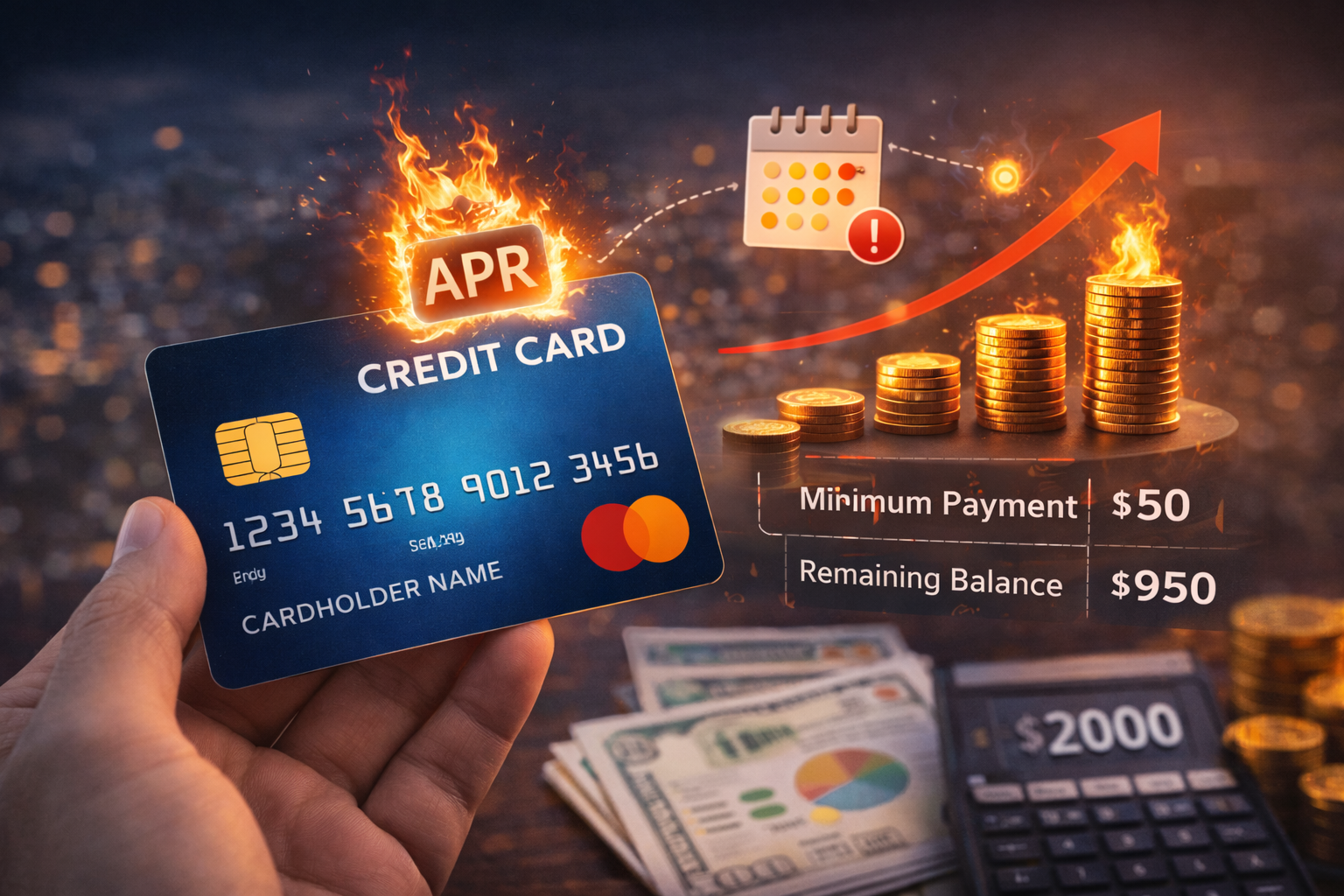
- You pay $1,000
- The least you can pay is $50
- Balance left: $950
- There will be interest on $950
This costs a lot over time.
How do you figure out how much interest you owe on your credit card?
Most of the time, credit card interest is figured out daily, not yearly.
Banks turn APR into a daily rate:
APR ÷ 365 = Daily Interest Rate
Example:
- APR is 24%
- Divide 24 by 365 = 0.065%
The bank charges you interest every day until you pay off your balance.
Different kinds of credit card APR
Credit cards have different kinds of interest rates:
- APR for purchases
If you don’t pay the full balance, this is the interest rate that will be charged on regular purchases.
Example:
Buying food, clothes, and electronics.
- APR for Cash Advance
This is true when you take cash out of your credit card.
⚠ The APR on cash advances is usually much higher.
There is also no grace period, so interest starts right away.
- The APR for balance transfers
This APR applies when you move debt from one card to another.
Some cards give you:
✅ 0% APR for a short time
Then the normal interest starts.
- Penalty APR
The bank may raise your interest rate if you miss payments.
The penalty APR can be as high as:
35% or more
Paying bills late can cost you a lot.
Interest Rates That Stay the Same vs. Change
APR that stays the same
Doesn’t change very often.
Variable APR
Changes that depend on interest rates in the market.
A lot of credit cards these days have variable APR.
Why Are Interest Rates on Credit Cards So High?
Credit cards are loans that don’t require collateral, which means:
- The bank gives you money without any security.
Banks charge more interest on loans than on personal loans or mortgages to lower their risk.
How to Not Pay Interest on Your Credit Card
Here are some easy tips:
✅ Pay the full balance every month
The best way to never pay interest.
Don’t carry debt over.
Don’t roll over your balances.
✅ Don’t take out cash advances.
Taking money out costs more.
Use credit cards wisely.
Pay back only what you can afford.
Pick cards with low APRs.
Before applying, look at different cards.
What’s the difference between interest and fees?
A lot of people get interest and fees mixed up.
Feature Interest Fee
Charged when the balance isn’t paid for certain actions
Example:
- APR on amount not paid
- Fee for being late
- Yearly fee
Can you avoid it?
- Yes, pay in full
- Sometimes
Scenario Examples
Scenario 1 (Smart User)
Costs: $500
Pays the full amount on the due date
✅ No interest charged
Scenario 2: The Person Who Uses Debt
Costs: $500
The least you can pay is $25
$475 left to pay
❌ Interest charged every month until paid
That $500 purchase could end up costing $600 or more over time.
Common Questions About Credit Card Interest Rates
Q1: Do I have to pay interest right away?
No, not if you pay in full during the grace period.
Q2: Is APR charged every month or every year?
APR is yearly, but interest is added to the balance every month.
Q3: Is it possible to avoid interest altogether?
Yes, by paying the full amount every month.
Q4: What will happen if I miss a payment?
You might have to pay late fees and a higher penalty APR.
Last Thoughts
It may seem hard to understand credit card interest rates, but once you know what APR and grace periods are, it’s easy to handle credit cards.
Remember:
✅ Pay off your balance in full.
✅ Don’t depend on minimum payments.
✅ Don’t take out cash advances.
✅ Use credit cards as a tool, not extra money.
You can enjoy the benefits of credit cards without getting into debt if you use them wisely.

