

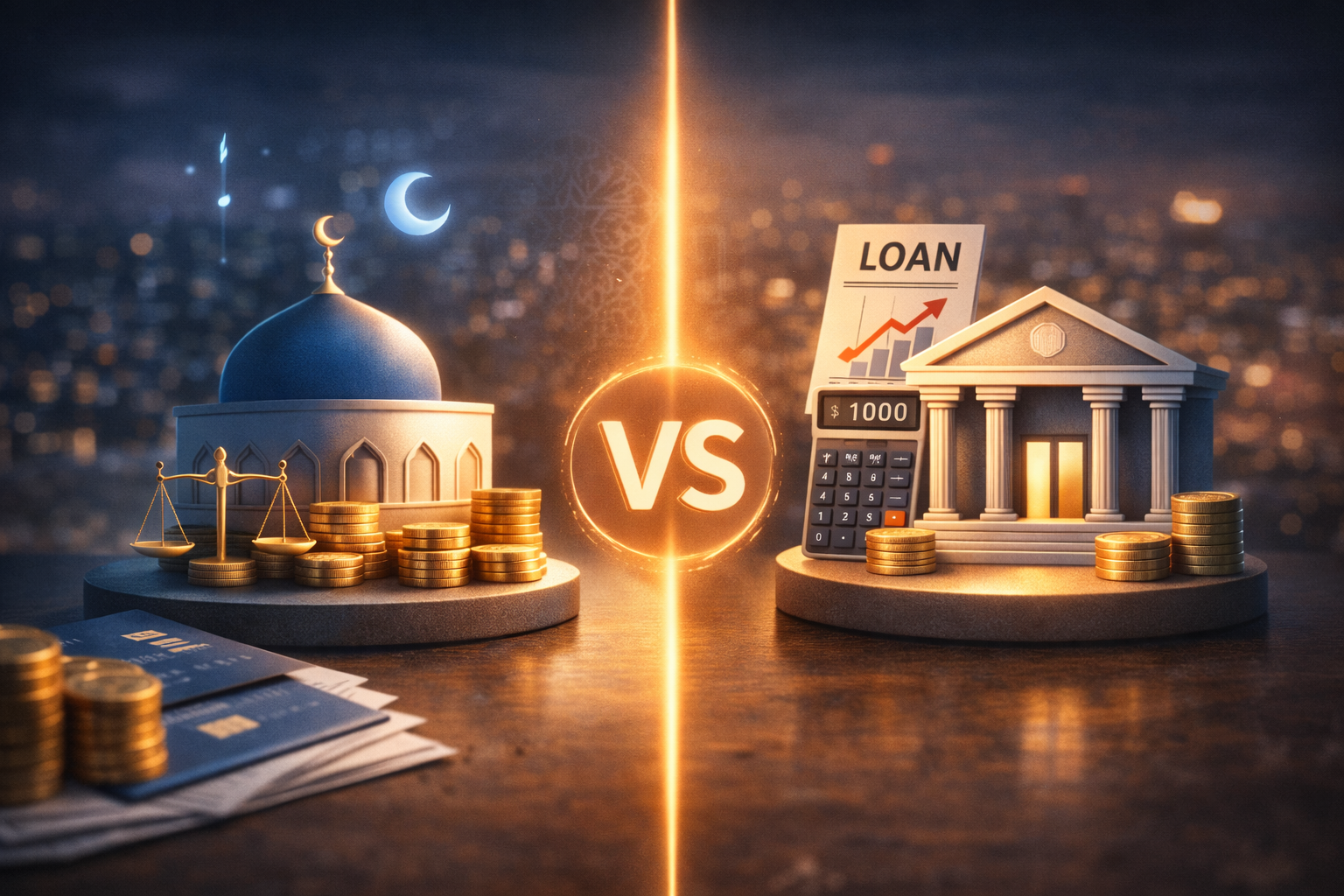
Banking is a big part of modern economies because it makes it easier to save, invest, and do business. Islamic banking and conventional banking are two major banking systems that have grown up around the world over time. Both want to help people with their money, but they do so in very different ways.
A lot of people want to know what makes Islamic banking different from regular banking, which system is better, and which one is best for their money needs. The differences go beyond just religion; they also include ethics, structure, and how things work.
This full guide makes it easy to understand the differences between Islamic banking and regular banking. You will learn how each system works, what its main ideas are, what its pros and cons are, and how to choose the best banking model for you.
What Is the Normal Way to Bank?
The most common type of banking around the world is conventional banking. It works on interest-based transactions, which means that money is seen as a commodity that can make money by being lent.
In regular banking:
- Customers can put money into banks
- Banks give interest on savings
- Banks charge higher interest rates on loans
- The bank makes money by charging more interest than it pays out
Most banks around the world use this system.
What Is Banking in Islam?
Islamic banking is a way of doing business that follows Islamic financial rules, which are also known as Shariah rules. These principles stress being fair, open, and honest with money.
Some important things about Islamic banking are:
- No interest (riba)
- Sharing profits and losses
- Transactions backed by assets
- Investing in a way that is moral
Islamic banking is meant to make sure that money is spent wisely and well.
Basic Ideas Behind Islamic Banking
To know the difference well, you need to know the basic ideas behind Islamic banking.
No Interest (Riba)
Islamic banking does not let you pay or earn interest. People don’t think of money as an asset that makes money.
Sharing the Risk
The bank and the customer both make money and lose money. This encourages people to act responsibly with their money.
Financing with Assets
Transactions must be connected to real goods or services, not lending money for fun.
Investments That Are Good for the World
Islamic banks don’t put money into businesses that are thought to be bad, like gambling, or businesses that don’t follow the rules.
Basic Ideas Behind Traditional Banking
There are different rules for traditional banking:
System Based on Interest
Banks make most of their money from interest.
Returns That Are Set
Depositors are guaranteed interest, no matter how the bank does.
Financing Based on Debt
People who borrow money must pay back the principal plus interest.
Maximizing Profit
Banks mostly care about making money within the law.
Key Differences Between Islamic and Conventional Banking
Feature | Islamic Banking | Traditional Banking |
|---|---|---|
Interest | Not allowed | Allowed |
Risk Sharing | Shared by the bank and the customer | Mostly paid for by the customer |
Type of Transactions | Asset-backed | Debt-based |
Investment Focus | Ethical and Shariah-compliant | No religious restrictions |
Profit Method | Partnership and trade | Fees and interest |
How Deposits Work in Both Systems
Deposits in Regular Banking
- Customers put money in
- The bank pays a set amount of interest
- You are sure to get your money back
Banking with Islamic Deposits
- Deposits could be based on sharing profits
- Returns depend on how well the bank does
- No interest is guaranteed
This difference shows the main idea behind both systems.
How Loans and Financing Work
Loans from Traditional Banks
- The borrower gets money
- Pays back the principal and interest
- The interest rate can be fixed or variable
Financing for Islamic Banking
Islamic banks use different types of structures, such as:
- Agreements to share profits
- Financing with cost-plus
- Models based on leasing
The bank makes money by trading or working with other businesses, not by charging interest.
Comparing Profit and Risk
Traditional Banking
- The bank makes money no matter what happens
- The borrower takes on most of the risk
- Losses do not lower the bank’s interest income
Banking in Islam
- The bank shares the risk with the customer
- Profit depends on how well the deal goes
- Promotes responsible lending
Ethics and Openness
Islamic banking puts a lot of importance on being open, fair, and acting morally.
- Terms of the contract are clear
- No extra interest fees
- Screening for ethical investments
Standard banking is open about its rules, but it doesn’t stop people from making investments based on their morals or religion.
Benefits of Islamic Banking
- Focuses on investments that are fair and good for society
- Sharing risk supports fair financial relationships
- Transactions backed by assets reduce risky behavior
- Appeals to people who dislike interest-based systems
Disadvantages of Islamic Banking
- Limited product availability
- Structures that are hard to understand
- Returns that change and are not guaranteed
Benefits of Traditional Banking
- Easy-to-understand interest-based products
- Available almost everywhere
- Predictable returns
- Faster loan processing
Drawbacks of Traditional Banking
- Interest burden on borrowers
- Risk imbalance
- No ethical investment restrictions
Which Banking System Is Better?
There is no one answer that fits all. The best system depends on your needs, beliefs, and money goals.
Islamic Banking Is Better If:
- You prefer ethical and interest-free finance
- You are comfortable sharing profits and losses
- Asset-backed transactions matter to you
Traditional Banking Is Better If:
- You want stable and predictable returns
- You need wide product availability
- You prefer simpler financial structures
Many people use both systems for different purposes.
The Growth of Islamic Banking Around the World
Islamic banking is growing quickly because of:
- Increasing demand for ethical finance
- Expansion beyond Muslim-majority countries
- Government support in many regions
This growth shows Islamic banking is not limited to religion.
Common Misconceptions About Islamic Banking
- “Only Muslims can use Islamic banking.”
Anyone can use Islamic banking. - “Islamic banking doesn’t make money.”
It makes money through trade and partnerships. - “Islamic banking is outdated.”
Modern Islamic banks use advanced technology.
Frequently Asked Questions (FAQs)
Is there no interest at all in Islamic banking?
Yes, interest is not used, but profit is earned through trade.
Is it wrong to use regular banks?
Not legally, but it may not follow religious guidelines.
Can non-Muslims use Islamic banking?
Yes, Islamic banking is open to everyone.
Which banking system is safer?
Both are safe when properly regulated.
Final Thoughts
Islamic banking and conventional banking both provide financial services, but they operate in very different ways. Islamic banking focuses on ethics, assets, and risk sharing, while conventional banking relies on interest and wide availability.
Understanding these differences helps people and businesses choose what fits their values, goals, and risk tolerance. These systems are not competitors but alternative approaches to managing money.
The real question is not which system is better, but which one suits your personal and financial needs best.

